
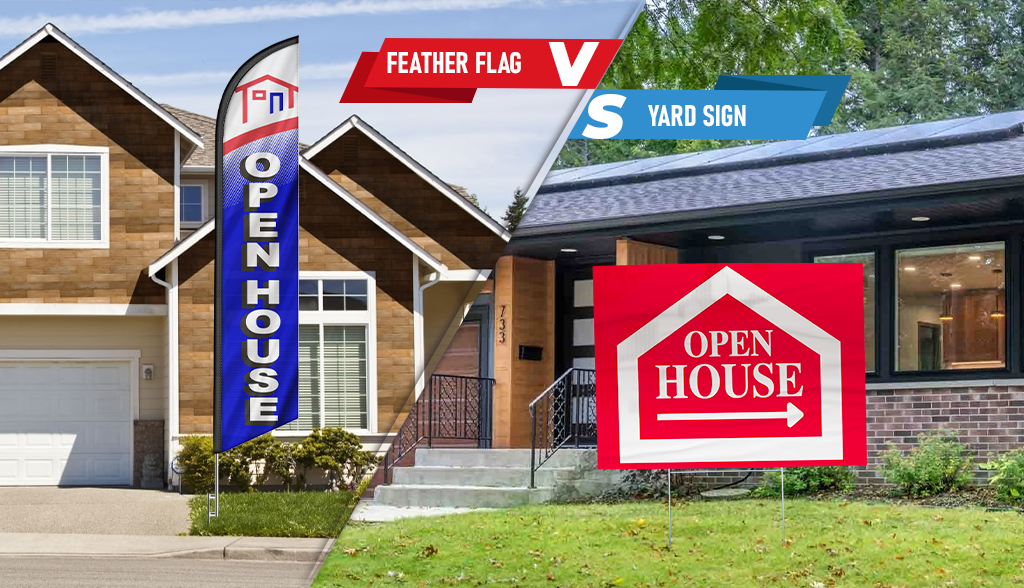
When hosting an open house, visibility plays a major role in attracting walk-in buyers. Two of the most common signage options agents use are feather flags and yard signs. But which one works better?
Understanding the differences between feather flags vs yard signs can help you choose the right setup for your listing and location.
What Yard Signs Do Well
Yard signs are a long-standing staple in real estate marketing. They are compact, familiar, and easy to place directly in front of a property.
Yard signs work well for:
- Clearly identifying the property
- Providing agent or brokerage information
- Reinforcing that the home is for sale
- Supporting directional signage
They’re especially effective once buyers are already nearby.
Where Yard Signs Fall Short
While yard signs are useful, they sit low to the ground and can easily blend into landscaping, parked cars, or surrounding neighborhood signage.
In busy areas or properties set back from the street, yard signs may not be visible from a distance. This can limit their ability to attract drive-by traffic.
How Open House Feather Flags Stand Out
Feather flags offer vertical height and natural movement, making them easier to notice from farther away. Their ability to move with the wind helps catch attention without additional effort.
Open house feather flags are especially helpful when:
- The property is on a busy road
- There are parked cars blocking visibility
- The home sits further back from the street
- You want added attention beyond traditional signage
Because they stand taller than yard signs, feather flags often remain visible above surrounding obstacles.
Size Options for Different Open Houses
Feather flags come in multiple sizes, giving agents flexibility based on the property and location.
- 12ft feather flags provide maximum visibility and are ideal for higher-traffic streets.
- 6ft feather flags are easier to transport between listings and work well for neighborhood open houses with lighter traffic.
Yard signs, by comparison, typically remain compact and consistent in size.
Placement Strategy Matters
Choosing between feather flags vs yard signs isn’t always about picking one over the other. Placement plays a key role in effectiveness.
A common strategy includes:
- Feather flags for roadside visibility
- Yard signs directly at the property
- Additional signage near intersections if needed
Using both together creates a layered approach that improves overall visibility.
What About Directional Arrows?
Directional arrows are commonly used on yard signs and work well because the sign remains fixed in place.
However, arrows are not recommended on feather flags. Since feather flags rotate with the wind, arrows can end up pointing the wrong direction and confuse visitors.
Instead of relying on arrows on flags, use strategic placement and multiple signs to guide buyers naturally.
Which One Attracts More Walk-Ins?
In terms of grabbing attention from a distance, feather flags typically outperform yard signs because of their height and movement.
However, yard signs still play an important supporting role by clearly marking the property and reinforcing agent information.
The most effective open house setups often combine both signage types for maximum impact.
Final Thoughts
When comparing feather flags vs yard signs for open houses, the best solution isn’t always choosing one over the other. Feather flags help attract attention from the street, while yard signs clearly identify the property once buyers arrive.
By combining vertical visibility with traditional signage, agents can create a professional, easy-to-follow setup that attracts more walk-in traffic.